Rush screen printing buys priority on the press schedule. Curing, proof approval and carrier transit still run on their own clocks, so we work every deadline backward from the in-hands date.
Every item has a minimum of at least 12 pieces, set per product, and larger runs cost less per unit. Production starts only after you approve the proof.
Table of Contents
- How Fast Can Rush Screen Printing Actually Run
- Which Decoration Methods Can Be Rushed, and Which Cannot?
- How Do Colors, Locations and Quantity Change a Rush Order?
- What Artwork Must Be Final Before a Rush Can Start?
- How Can I Check the Print Quality of a Rush Order?
- How Much Does a Rush Charge Add to My Order?
- How Do I Confirm My Delivery Date Before I Approve?
- What Do Buyers Ask About Rush Screen Printing?
How Fast Can Rush Screen Printing Actually Run
Rush screen printing is a priority production schedule for screen-printed orders that shortens the wait for press time but never skips screen exposure, ink application or curing. We assess feasibility order by order, using the artwork, stock availability and available production capacity rather than promising a universal turnaround.
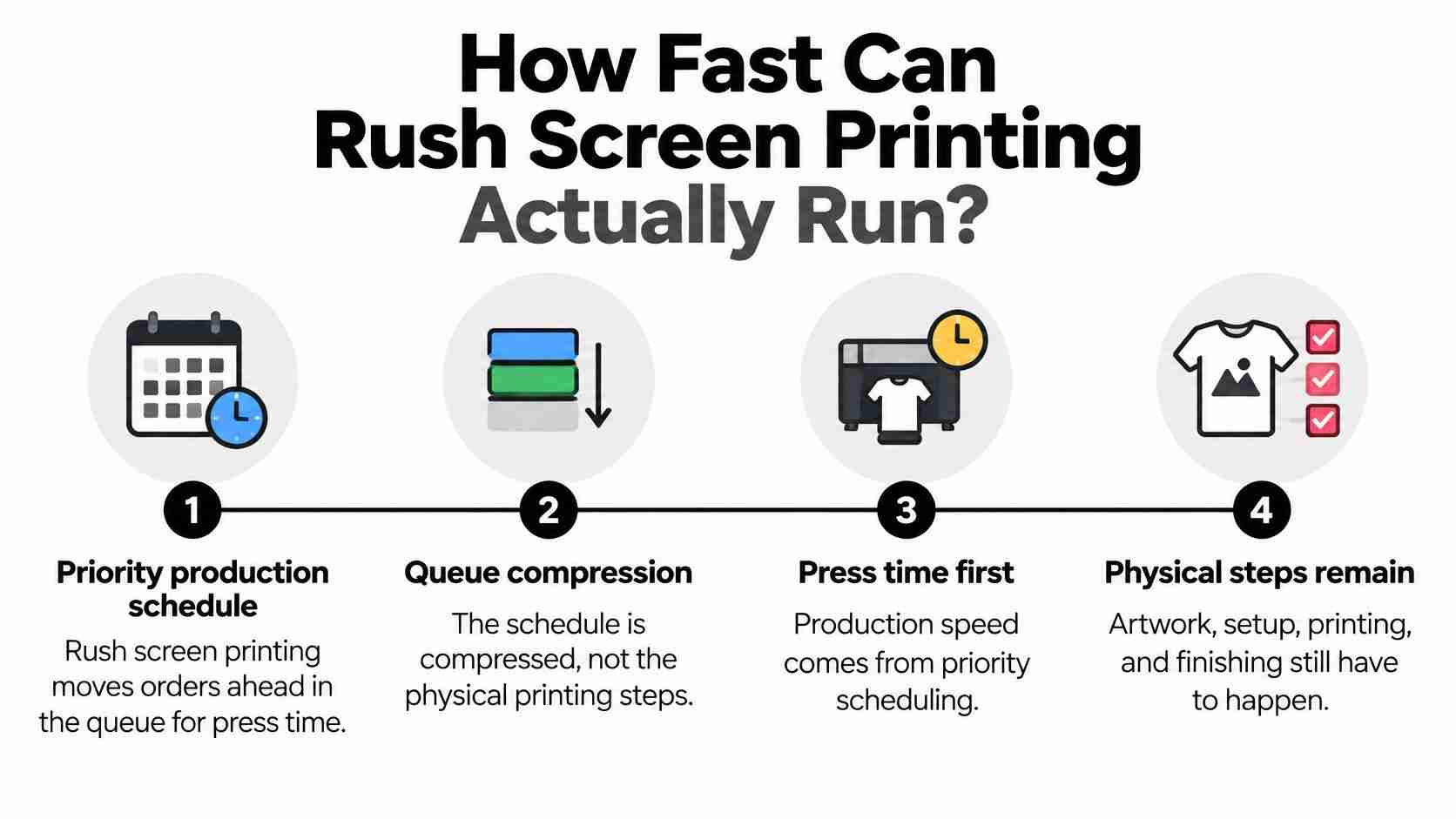
Rush screen printing stages and what controls each one
| Stage | What happens | What can shorten it | Who controls it |
|---|---|---|---|
| Quote | We price the order and confirm method, colors and quantity | Complete details with the in-hands date | You and us |
| Art prep | We manage color separations and print-ready file preparation | Final vector artwork | You supply art; we handle preparation |
| Proof approval | You review a free virtual proof before payment | Approval without revisions | You |
| Production | Screens are exposed; ink is applied and cured | Available blanks, open press time and fewer colors | We manage scheduling around stock and capacity |
| Delivery | Carrier transit to your destination | Choosing shipping early | The carrier; we coordinate shipment |
Production time starts when the proof is approved, not when the order is placed. A production completion date isn't an arrival date, so carrier transit needs its own window.
Send the item, quantity and in-hands date with your quote request so we can assess whether the deadline is realistic. We're CustomMark, based in Coral Gables, Florida; we ship nationwide and quote in English or Spanish.
Which Decoration Methods Can Be Rushed, and Which Cannot?
Screen printing and direct-to-garment printing can accommodate compressed schedules when artwork and stock are ready; embroidery is harder to accelerate because stitching takes time.
| Method | Best for | Durability | Price-break behavior | Lead time |
|---|---|---|---|---|
| Screen printing | Identical designs on apparel and suitable drinkware | Excellent on cotton, canvas and non-woven materials | Lowest per unit at volume once setup is spread across the run | Can compress; additional colors lengthen setup |
| Embroidery | Polos, hats and workwear | Very durable stitched finish | Cost follows stitch count and quantity; volume supports breaks | Harder to compress because stitching sets the pace |
| Direct-to-garment | Smaller runs with full-color art on cotton | Good on cotton with appropriate care | Price falls less steeply as quantity increases | Often quicker for small full-color runs because there are no screens |
Screen printing suits repeatable graphics, including staff shirts and school merchandise. Each additional ink color introduces another screen and registration work, so simplifying artwork can make a deadline more achievable.
Direct-to-garment avoids screen preparation, making it useful when detailed artwork matters more than volume savings. Embroidery gives polos and workwear a stitched finish, and we recommend it when the job suits it, even when the per-piece cost is higher.
Start with T-shirts for screen-printed apparel, or compare screen printing and heat transfer when deciding whether to change methods. Make that decision before approving the artwork, not after the schedule is committed.
How Do Colors, Locations and Quantity Change a Rush Order?
Colors and print locations add setup, while quantity determines how widely that setup cost is spread. Each product page shows the exact minimum and published quantity pricing, so use the selected product's requirements rather than assuming every shirt has the same threshold.
| Order detail | What it changes | What to finalize |
|---|---|---|
| Ink colors | Screens, separations and registration | Approved color count, including any underbase |
| Print locations | Separate positioning and setup work | Front, back and sleeve requirements |
| Quantity | Total production workload and setup cost per piece | Final total and size breakdown |
| Blank stock | Whether sourcing fits the deadline | Style, garment color and every required size |
Each color needs its own screen, but that doesn't mean every color receives a separate full cure cycle. Intermediate flashing may be necessary, and the completed ink system still needs proper curing.
A front-and-back design adds handling and setup compared with a front-only design. Keep placements that carry useful information, and remove decorative extras if they threaten the date.
Stock must cover the actual size distribution, not just the total quantity. Before finalizing artwork, settle the order count and review how promotional product price breaks affect the purchase.
What Artwork Must Be Final Before a Rush Can Start?
The artwork, dimensions, placements and order details must be settled before proof approval can release a rush order into production. We handle file preparation; you supply the originals and approve the result.

- Send vector artwork. AI, EPS or vector PDF files preserve clean edges. A low-resolution JPG may require a redraw.
- Identify colors. Supply Pantone numbers or hex values and flag brand-critical matches. A screen preview alone isn't a physical ink standard.
- Specify size and placement. Mark dimensions for every location using our shirt printing template.
- Include the size breakdown. Late changes can require another layout check or revised proof.
- Approve the complete proof. Check wording, colors, dimensions and garment details together.
For jacket projects involving patches rather than printed graphics, settle the attachment method separately from the artwork.
We retain artwork, stitch files, screens and job specifications for 2 years, so unchanged reorders run from approved originals without re-digitizing or repeat setup charges. A complete file package lets us confirm a workable rush date in writing.
How Can I Check the Print Quality of a Rush Order?
Check the proof before approval, then inspect the garments before distribution. The proof catches specification errors; receiving checks catch physical print defects that a virtual image can't show.
- Compare color references. Check the specified Pantone numbers or hex values, not just the appearance on your display.
- Verify dimensions. Match placement and print size to the written specification. Don't estimate measurements from the mockup.
- Reconcile the quote. Confirm that color count and print locations match what you approved.
- Inspect across the shipment. Check several garments for misregistration, uneven coverage, missing detail and inconsistent placement.
- Wash a garment promptly. Follow its care instructions and inspect for cracking, fading or ink loss before distributing the remaining pieces.
A wash check can reveal a problem, but it doesn't replace production cure verification. Ink that feels dry at the surface may still be inadequately cured through its thickness.
Our explanation of UV light in screen printing distinguishes screen preparation from ink curing. Raise proof questions before approval, and leave room between receipt and the event for inspection and a possible replacement shipment.
How Much Does a Rush Charge Add to My Order?
The rush charge is quoted for the specific order and pays for priority scheduling and any additional production capacity needed. It isn't a universal surcharge, and expedited shipping is a separate expense.
Compare the complete delivered cost, not just the per-piece figure. Decoration method, colors, placements, quantity and deadline all affect the quote.
A usable rush quote should state:
- Production completion date, with any conditions attached.
- Rush handling, showing whether it's included or listed separately.
- Shipping method and destination, including separate delivery addresses.
- Proof approval deadline, so the schedule has a clear starting condition.
- Per-piece pricing and setup, with separate charges identified.
A paid rush charge without a written schedule isn't enough to plan an event around. Ask us to price against the actual in-hands date so we can account for both production priority and transportation.
For an unchanged reorder, identify the approved original artwork when requesting pricing. Reorder discounts depend on the type of order, so don't assume a fixed percentage reduction.
How Do I Confirm My Delivery Date Before I Approve?
Confirm the proposed arrival date and its conditions before approving the rush order. We handle tighter-than-standard deadlines through rush production when the method, stock and capacity allow it.

Work backward rather than adding optimistic estimates forward:
- Fix the in-hands date. Use the date you need to receive and inspect the goods, not the event's opening time.
- Allow transit to each destination. Split shipments need destination-specific windows.
- Set the approval cutoff. Leave the full agreed production window after approval.
- Verify stock. Confirm the style, color and required sizes.
- Document both dates. Get production completion and expected arrival in writing, with carrier assumptions.
Production is measured from approval; transit is measured from shipment. Neither date establishes the complete schedule by itself.
If the event date is fixed, treat proof approval as a hard deadline. Don’t assume a rush charge can recover time lost to a late approval.
Derek Capo, owner, CustomMark
For mixed merchandise orders, assess rush promotional products against the same receiving deadline. If the window doesn't work, change the method, available garment or quantity before final approval.
What Do Buyers Ask About Rush Screen Printing?
How much do rush screen printed shirts cost?
The cost depends on garment selection, decoration method, colors, locations, quantity and deadline. Request a quote that separates production rush handling from shipping so you can compare the full delivered total.
What is the minimum order for rush screen printed shirts?
Every item has a minimum of at least 12 pieces, with the exact minimum determined by the product and decoration method. Check the product page for its minimum and published quantity pricing, then send the quantity with your quote request.
How long does it take to get rush screen printed shirts?
Production starts when the proof is approved, and the schedule depends on blank stock, artwork complexity and available capacity. Request a quote with your destination and in-hands date so we can confirm production and delivery windows in writing.
Does rush screen printing include shipping?
No, rush production and carrier transit are separate scheduling windows. We ship nationwide, and the quote should identify the shipping method and transportation charges.
Do I have to approve a proof before production starts?
Yes, approval is required before production begins, and every quote includes a free virtual proof before payment. Review the complete specification rather than approving only the logo's appearance.
We source the blank, manage the decoration and coordinate nationwide shipping for deadline-driven merchandise orders. Visit CustomMark to choose an item we can assess against your artwork and receiving deadline.
Ready to price it? Send us screen-printed apparel and the proof approval date, the quantity, your in-hands date and your artwork file, and we’ll come back with real pricing. Start a quote or call 1.888.452.0027.