Most groups lose money on fundraiser T-shirts to leftover sizes, not to a higher per-shirt blank cost. According to SizeMarker's fashion returns analysis, U.S. online apparel returns reached an estimated 24.4%, with size and fit accounting for roughly 52% to 58% of those returns, and a volunteer group has no returns department to absorb bad guesses.
That is why the first budget decision is the order path. Preorders, a tight size plan, and a clear reorder path protect proceeds better than shaving a few cents from a blank. Custom Mark sources blanks, manages decoration, and ships nationwide. Minimums vary by product and decoration method, with 12-piece minimums on many apparel items and price breaks that typically begin between 50 and 250 pieces.
Table of Contents
- How Do Fundraiser T-Shirt Programs Work?
- Which Shirt Fabric Lasts Longest for Fundraisers?
- Which Decoration Method Fits Your Fundraiser?
- How Many Shirts and Which Sizes Should You Order?
- How Do You Price Shirts and Calculate Net Proceeds?
- How to Run the Preorder Window and Timeline
- Confirm Your Quantity and Size Mix Before You Ask for a Quote
- Fundraiser T-Shirt Questions Buyers Ask
How Do Fundraiser T-Shirt Programs Work?
Fundraiser T-shirts are custom shirts that carry a group's name or cause and are sold or handed to participants to raise money. Schools, nonprofits, youth sports leagues, race and walk organizers, and trade show teams run these campaigns to fund travel, equipment, scholarships, or community programs.
Tying apparel to a goal works better than handing shirts out at random. A 2017 analysis of 83 U.S. fundraising programs operated by 33 organizations, reported by Nonprofit PRO, found that participants who redeemed recognition items such as event shirts raised an average of $1,097, compared with $865 among those who declined. Redeemers also raised more than non-redeemers in 98% of the programs studied, even though motivated fundraisers may be more likely to claim a shirt and raise more money.
Groups running promotional products for nonprofits usually pick one of three fulfillment models before setting prices:
- Preorder-only runs: Orders and payments close before any blanks are ordered or decorated, which keeps leftover inventory near zero.
- Event-stock runs: Shirts are decorated ahead of time and sold on-site at games, booths, or races, giving you impulse sales while leaving unsold sizes on your budget.
- Hybrid runs: You lock in a paid preorder first, then add a small on-site reserve in your most popular adult sizes.
If you're weighing how preorders protect your margins on small community sales, Ovenbell's breakdown of pricing and preorders for bake sales shows the same demand-first logic in action. A fixed event date and a known roster favor a preorder, while open walks and community races usually favor a hybrid model.
Which Shirt Fabric Lasts Longest for Fundraisers?
The best fundraiser shirt is the one supporters wear most, so choose the fabric for long-term wear first. Supporters keep comfortable, durable shirts in rotation for years, turning one order into steady visibility for your cause.
The three common options behave very differently once washed:
- 100% cotton: Feels soft and familiar right out of the box, though it needs gentler washing to hold its shape and color over time.
- 100% polyester: Holds color well, resists shrinking, and dries quickly, making it a strong pick for 5Ks and youth sports.
- 50:50 cotton-polyester blend: Splits the difference on softness and durability, where the blank's fabric weight matters just as much as the fiber label.
Fiber alone doesn't settle the environmental footprint of your run. A European Commission Joint Research Centre study modeling 100% cotton, 100% polyester, and a 50:50 blend for "wearing one T-shirt for one day" found that polyester and blended shirts produced lower impacts than 100% cotton under its baseline, yet washing temperature, tumble-drying, garment lifetime, and end-of-life handling shifted those results heavily.
Cutting waste starts with making shirts people keep, since the United Nations Environment Programme figures in UN-Habitat's Zero Waste Day report put global textile waste at roughly 92 million tonnes per year while noting the sector's substantial greenhouse-gas emissions. Use these steps to stretch every shirt's lifespan:
- Specify a durable blank with a stated fabric weight, and compare fibers using our guide to cotton vs. polyester shirts.
- Recommend washing at lower temperatures so inks and fibers hold up longer.
- Advise buyers to skip the tumble dryer when possible to cut shrinkage and wear.
- Print that simple care line right on your sales page or packing slip.
Choose an evergreen graphic instead of a single-date flyer so leftover or second-round pieces stay wearable next season. Groups serving youth audiences can borrow wearable graphic ideas from collections like Bridle Up Hope Shop's equestrian hoodie gift ideas for kids, where clean artwork holds up past one weekend. Never treat a "sustainable" tag on its own as proof of lower total impact without durable construction and a reuse or donation plan.
Which Decoration Method Fits Your Fundraiser?
Match your decoration method to your artwork complexity and order quantity before you finalize the blank. We manage the decoration on every order we source, so once you pick the method, we handle file preparation, proofing, and fulfillment.
| Method | Best for | Durability | Price-break behavior | Lead time |
|---|---|---|---|---|
| Screen printing | Bold logos in one or two colors on cotton tees at volume | High on bold designs, wears well over many washes | Unit cost drops clearly as quantity rises | Longer when many colors need separate screens |
| Embroidery | Polos, caps and fleece where a stitched mark looks premium | High, stitching holds through repeated washes | Price follows design size and stitch count, so breaks are less steep | Usually longer than heat transfer because setup scales with design size |
| DTF (direct-to-film) | Full-color art, gradients and photos at small to mid runs | Good, but confirm wash results on your fabric | Gentler break curve, competitive at smaller quantities | Short setup, which suits tight in-hands dates |
| Heat transfer | Names, numbers and short runs with few colors | Moderate, edges can lift after many washes | Little volume discount on individual names | Quick setup for personalized names |
Before locking in your choice, run three quick checks on your artwork and apparel:
- Count your ink colors: One or two solid spot colors keep setup efficient at volume, while full-color art pushes smaller runs toward digital methods.
- Check fine detail: Tiny text, gradients, and photographs need a method built for detail rather than heavy ink or dense stitching.
- Match the fabric: Heavy ink feels different on lightweight polyester than on ring-spun cotton, and stitch-heavy crests need sturdy polos, caps, or fleece.
If you're deciding between ink and applied transfers for a team or school run, review our breakdown of screen printing vs. heat transfer. Always check the item's minimum on its product page before locking your quantity, and verify placement and colors carefully on the virtual proof we send. For most fundraisers running a bold one- or two-color logo at volume, screen printing is the default pick.
How Many Shirts and Which Sizes Should You Order?
Order against your paid preorder count plus a small reserve, never against the total headcount of your organization. A wrong size turns immediately into a stranded shirt, because a school or nonprofit rarely has a retail returns desk or an easy way to resell odd sizes.
Size guesswork creates waste even when buyers have digital tools. An international dataset covering 496,365 items ordered by 75,707 customers across 113 countries, published on ScienceDirect, found that incorrect fit was the primary stated reason for returns, and shoppers using a digital size finder were still 0.65% more likely to return an item.
| Size group | How to forecast it | Common mistake |
|---|---|---|
| Adult unisex, S to XXL | Use preorder size counts and reserve the middle sizes | Ordering by total shirt count without a size split |
| Youth sizes | Count registered children and parent preorders separately | Assuming youth sizes scale down from adult demand |
| Women's cut | Ask for the cut on the preorder form because fit differs from unisex | Treating a unisex size chart as a women's chart |
| Extended sizes, 3XL and up | Collect as preorder only and keep the reserve minimal | Stocking them on site for walk-up buyers |
Tightening your size collection before you submit the order protects both your margin and wearer satisfaction:
- Publish garment-specific chest width and body length specs using our T-shirt measurements guide instead of relying on generic S to XXL labels.
- Put a printed measurement chart or sizing reference at registration tables and on your signup page.
- Require buyers to pick both their cut and size on the preorder form before checkout.
- Keep your on-site reserve small and concentrated in your most requested middle adult sizes.
- Track youth and women's cut totals in separate columns so they never get lumped into unisex counts.
Because fundraiser shirts are often ordered before final event attendance is known, letting your paid preorder count anchor the run keeps your budget safe.
How Do You Price Shirts and Calculate Net Proceeds?
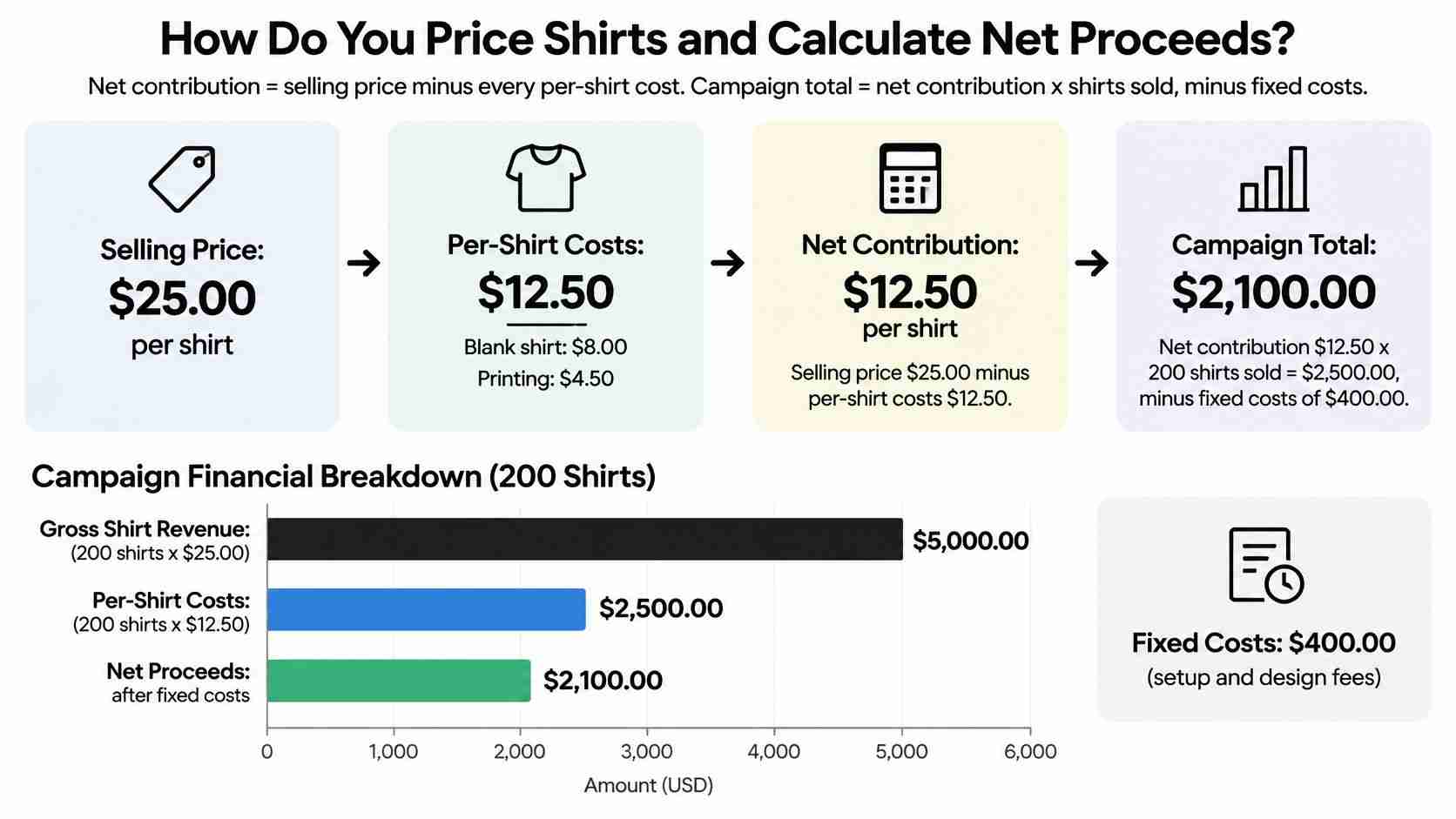
A shirt's net contribution is its selling price minus every per-shirt cost, and your campaign total is that figure multiplied by the shirts you sell, minus fixed costs. Many groups focus only on the blank price and forget freight, payment fees, and unsold reserve sizes.
This visual breaks down how a sample shirt price moves from gross revenue down to real net proceeds after per-shirt and fixed costs.
Map every cost line before you announce a retail price to supporters:
| Cost line | What it covers | Who sets the figure |
|---|---|---|
| Blank garment | The shirt itself, set by fabric and quantity | Quoted by us for your quantity |
| Decoration | Ink, thread or film for your method and colors | Quoted by us per order |
| Artwork and setup | File preparation and digitizing for stitched work | Quoted by us; repeat orders run from approved files |
| Shipping | Freight to one address or several sites | Quoted by us |
| Payment fees | Card or platform charges on each sale | Your payment provider |
| Unsold and exchanged shirts | Stock you cannot sell at full price | Your preorder count and size mix |
Run your math with one clean formula before launching sales:
- Selling price: The full retail amount your supporter pays per shirt.
- Minus per-shirt cost: Your quoted blank, decoration, and per-order payment fee.
- Minus fixed costs: Your setup charges, shipping, and any unsold reserve pieces.
- Times shirts sold: Multiply your per-shirt net contribution by actual paid units, not total units ordered.
Because quantity shifts your unit cost, run this worksheet at two or three volume tiers using our bulk T-shirt pricing guide before you commit. You can also compare your worksheet against other seasonal campaigns like the Rockdale Wreaths fundraiser profit breakdown to see how organizers separate gross sales from true net profit.
For a quick walkthrough of how unit margins and campaign costs interact on an apparel run, watch this short video overview.
Check Your Tax Rules Before Launch
For U.S. tax-exempt organizations, merchandise revenue isn't automatically treated the same way for unrelated business income tax (UBIT). According to nonprofit tax guidance from SE4Nonprofits, selling T-shirts can qualify as a related activity when the sales directly further the group's exempt mission, while sales that don't directly advance that mission may be treated as unrelated business income regardless of how proceeds are spent. Document how the shirt connects to your mission and have your accountant or tax adviser review the plan before collecting payments.
How to Run the Preorder Window and Timeline
A tight preorder window protects the budget more than a slightly lower shirt price. Leftover sizes turn a good unit cost into dead stock, so close the store on a date, then build the production schedule backward from your in-hands date.
Defined deadlines give buyers a reason to decide now. A large-scale Kickstarter campaign study on arXiv found that 46% of projects succeeded while 54% failed. The same study reported that 39.7% of campaigns, or 60,191 campaigns, ran for 30 days, compared with 6.5%, or 9,784 campaigns, running for 60 days. Shorter, defined windows are easier to promote because every reminder has a clear closing date.
Build the calendar around four concrete steps:
- Set one target and one hard close date: Use a short preorder window that pushes supporters to order now instead of bookmarking the link for later.
- Tie the schedule to proof approval: Count production from the approved proof, not from order placement. Leave review time in the calendar, because late artwork sign-offs eat directly into the production buffer.
- Show the flat design accurately: Share front and back flat layouts in the exact colors the decoration method can reproduce. Mockups that stretch colors or placement create returns, complaints, and reprints.
- Plan a clean reorder path: Keep the approved artwork and digitized files together. A second-round order is easier when everyone can work from the original proof instead of rebuilding the file.
Repeat the fundraising goal and close date in every email and social post. Send a final-week reminder before the form shuts down, and keep the message practical: what the shirt funds, when ordering closes, and when buyers should expect delivery.
Don’t chase a lower per-shirt price by ordering extra sizes nobody asked for. Leftover shirts sitting in a closet erase the volume break you thought you saved.
Treat sizes as part of the budget, not a clerical detail. Preorders show the size mix, and a small planned reserve can cover late buyers without turning the whole order into a guess. If the campaign sells through, run a reorder from the approved proof rather than overbuying before the window closes.
Confirm Your Quantity and Size Mix Before You Ask for a Quote
A quote is only as accurate as the order details behind it. The budget risk in a fundraiser usually comes from the size mix and leftover stock, not from the sticker price on one shirt. Build the request around a real preorder count, a tight reserve, and a product that fits the decoration method you plan to use.
Here is a worked quote request that combines the planning decisions. Say you are planning a unisex tee campaign using screen printing for apparel at volume. Custom Mark offers screen printing for apparel at volume, which is the cheapest per unit with excellent durability, and works on cotton, canvas, and non-woven materials across 104 products. Choose the Jerzees Ultimate Ring-Spun Unisex T-Shirt, which uses screen print or embroidery, has a 12-piece minimum, 10 business day production, and starts at $5.70 each. If your preorder form returns 84 sold shirts, add a small reserve based on the sizes supporters chose, then submit the total count, the size split, and your in-hands date together. That gives the quote team a runnable number instead of a vague estimate.
Keep the size split specific. List adult unisex, youth, women's cut, and extended sizes separately. A broad “adult medium and large” guess leaves you with the wrong cartons and dead inventory. Preorders tell you where the demand sits. The reserve should protect late sellers, not turn into a speculative bulk buy.
Attach clean artwork with the request and name the decoration method you want. If the group later adds hats, polos, or outerwear, Custom Mark offers apparel including tees, hats, polos, and outerwear, printed or embroidered, with 2,163 apparel products in the catalog. Keep those add-ons in a separate quote line so the core shirt count stays clear.
CustomMark puts logos on apparel, drinkware, bags and tech, printed to spec and shipped nationwide.
Fundraiser T-Shirt Questions Buyers Ask
How much do fundraiser T-shirts cost?
The figure that matters is your cost per sold shirt, and unsold inventory distorts that math fast. A run of 50 shirts built on the Jerzees Ultimate Ring-Spun Unisex T-Shirt starts at $5.70 each for the blank and decoration, so a full sell-through at a typical fundraiser retail price leaves healthy margin, while ten leftover shirts in unpopular sizes can erase a third of it. Blank choice, decoration method, ink color count, and quantity all move the per-shirt number, so real pricing comes from a quote built on your actual size mix rather than a flat menu rate.
What is the minimum order for fundraiser T-shirts?
Minimums are set per item and vary by product and decoration method. Many T-shirts carry a 12-piece minimum, and many items across the catalog can be ordered as a single piece for sampling, which is useful when you want to check fabric weight or print quality on one shirt before committing to the full run. The product page for each blank shows its exact minimum, so confirm that number before you open your preorder window.
How long does it take to get fundraiser T-shirts?
Production time runs from proof approval, not from the day you place the order, and it ranges widely by blank. Some shirts decorate in 1 business day, others take 7 to 10 business days, and transit time sits on top of that. Slow artwork sign-off is the most common cause of missed event dates. If your fundraiser has a fixed distribution day, count backward from it and approve your proof the moment it arrives.
Can I reorder the same design?
Reorders are where a well-planned fundraiser saves real money. Approved artwork and digitized files are kept for two years, so a second batch runs from your originals with no repeat setup charge. A group that sells out in March can place a follow-up order in April, or even the following spring, using the same files and the same size breakdown adjusted for what sold. I recommend keeping notes on which sizes moved fastest, because that reorder is the cheapest place to correct a size mix that missed.
Do you ship nationwide?
Completed orders ship anywhere in the United States, to one destination or split across several. A booster club can receive its full run at the school, while a regional nonprofit can have boxes divided among chapter addresses, with freight built into the quote up front.
Will I see my design before the shirts print?
Proofing is part of every order. You review the layout, spelling, colors, and placement on a proof before anything enters production, and the production clock only starts once you sign off. Treat that review as a group task: one person checking spelling, another checking the logo colors, because a typo caught at proof costs nothing and the same typo caught on delivery day costs the whole run.
CustomMark supplies custom branded apparel, drinkware, bags, and promotional gear for schools, nonprofits, and community fundraisers nationwide, sourcing the blanks and managing the decoration from proof to delivery. Explore blanks, decoration options, and fundraising ideas directly at Custom Mark.
Ready to price it? Send us your fundraiser T-shirt style and preorder size mix, the quantity, your in-hands date and your artwork file, and we’ll come back with real pricing. Start a quote or call 1.888.452.0027.